
How Do You Pay for the Schools?
Published:
Hays CISD voters approved $968.65 million in school bonds in May 2025. Six months later, the same district asked them to raise the operating tax rate by 12 cents per $100 of valuation. They said no — 60 percent to 40 percent.
The two votes summarize the strange logic of Texas school finance. Hays County is one of the fastest-growing places in America. The school district is adding roughly 900 students a year. The property tax base is rising even faster. By any normal accounting, this is a district swimming in revenue. And yet the district is staring at a $20 million budget shortfall and has announced cuts for the 2026–27 school year.
How does that work?
Two pots of money
Texas school districts have two tax rates, and they pay for different things.
Maintenance and operations (M&O) pays for everything that happens after the school is built: teachers, supplies, buses, electricity, lunches, special education services. M&O is what funds the day-to-day operation of the schools. Hays CISD’s M&O rate in 2025 was $0.6669 per $100 of taxable value.
Interest and sinking (I&S) pays for the debt service on bonds the district has issued to build, expand, and renovate facilities. I&S is what builds new schools. Hays CISD’s I&S rate was $0.4877 per $100. The May 2025 bond — $968.65 million across four passing propositions — funds new schools, safety upgrades, technology, transportation, and athletic facilities.
The voters who approved the bond in May and rejected the M&O increase in November were largely the same people. They said yes to building new schools and no to paying to operate them.
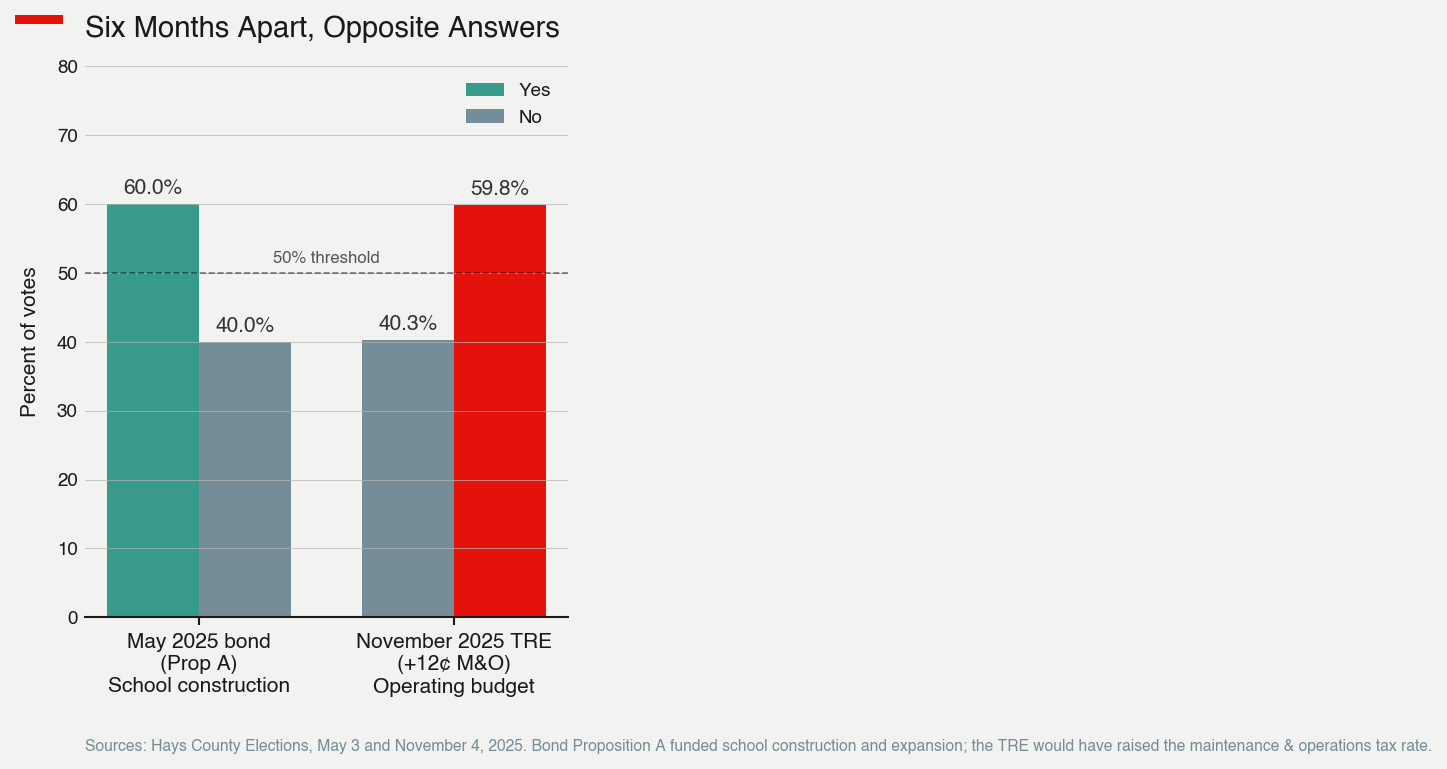
There is a coherent logic to that split, even if it produces an impossible budget. Bond debt is paid by all taxpayers across the district, including commercial property and second homes, and is spread over thirty years. The cost shows up on tax bills slowly, in small annual increments. An M&O rate increase is recurring, immediately visible, and almost entirely paid by homeowners. After several years of rising property values, asking those homeowners to vote themselves a 12-cent rate increase was — for most of them — a hard no.
The squeeze
Here is the strange part. Even with the M&O rate held flat, you might expect a district whose tax base just grew 8.83 percent to have substantially more money to spend per student. It does not.
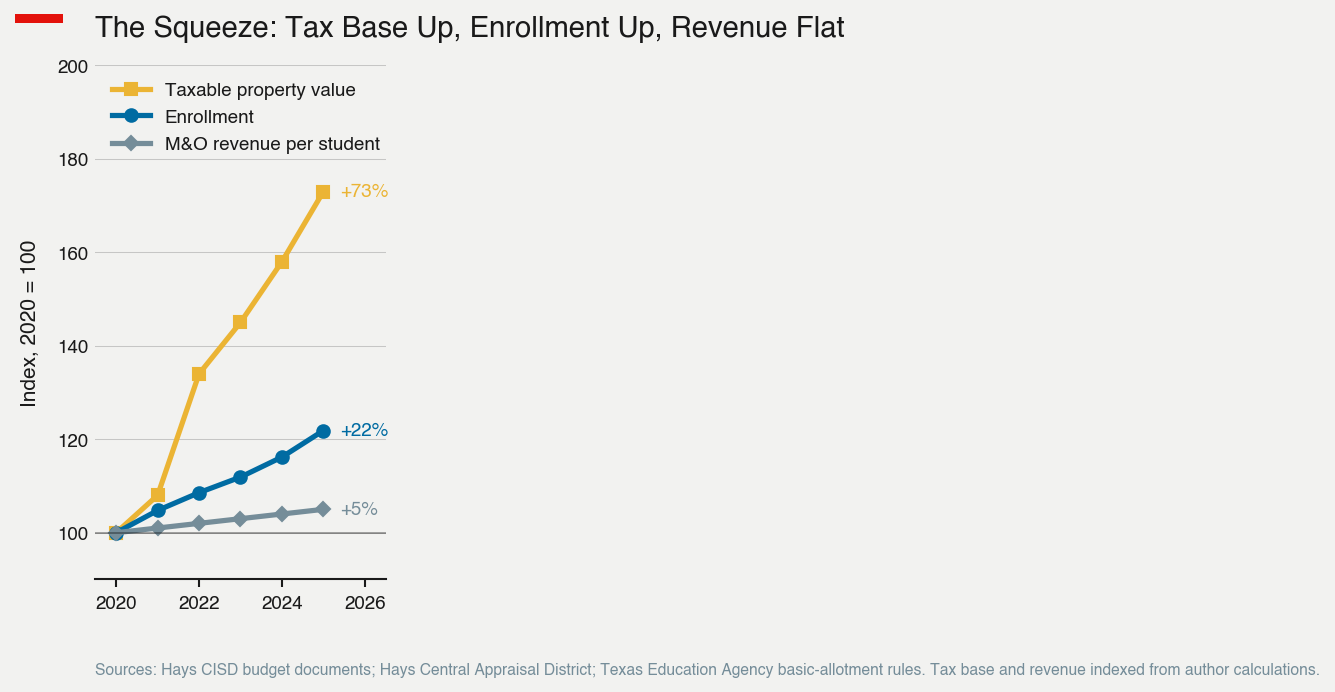
Between 2020 and 2025, the Hays CISD tax base grew about 73 percent. Enrollment grew about 22 percent. M&O revenue per student grew about 5 percent — barely above inflation in any one year, and below it in real terms cumulatively.
The reason is the structure of Texas school funding. The state’s Foundation School Program contributes the difference between what a district raises locally and a target funding level set by the legislature. When local property values rise, the state forces a corresponding cut to the M&O rate — a process called compression — to keep total per-student revenue roughly flat. This has been one of the main ways the legislature has delivered “property tax relief” over the past several years.
The result is that even when a district’s property values rise 9 percent, its M&O revenue per student grows much more slowly — often barely at all in real terms. A growing district like Hays CISD ends up running harder to stand still. Enrollment grows, salary costs rise with inflation, special education needs increase, and the state’s basic allotment stays at $6,160 per student, where it has been since 2019. Voting against the M&O rate increase did not save Hays CISD homeowners much, because most of any tax-rate reduction would have been clawed back by the state. But it did deny the district a tool it badly wanted to use.
Recapture
If a district’s tax base rises far enough relative to its enrollment, it eventually crosses into territory where the state determines it has “more than its share” of local wealth. At that point, Chapter 49 of the Texas Education Code — the so-called Robin Hood provision — requires the district to send a portion of its local tax collections back to the state for redistribution to property-poor districts.
Austin ISD, just up the highway, sends back over a billion dollars per year. Eanes ISD, which serves the wealthy enclaves around Westlake, sends back more than half of its local property tax collections. These transfers are often the largest single item in the district’s budget.
Hays CISD is not currently a recapture district. As of the most recent reporting, the district is property-poor enough to receive state aid rather than send it back. But it is, in the words of one local report, “getting there.” Property values have grown faster than enrollment for several years running, and the math is moving in one direction.
If Hays CISD becomes a recapture district — which is increasingly plausible given the trajectory — a portion of every additional dollar collected from Hays homeowners would flow back to the state rather than to Hays schools. The district would face the worst version of the squeeze: a tax base that looks rich on paper, a student population that is overwhelmingly middle-class and growing, and a transfer obligation that compounds the problem.
San Marcos has the opposite problem
The other school district in the county, San Marcos CISD, faces a different version of the same constraints.
SMCISD is not property-wealthy and is not subject to recapture. About 75 percent of its students are classified as economically disadvantaged. The district depends heavily on state aid, federal Title I funding, and (where voters approve it) supplemental local revenue raised through a Voter-Approval Tax Rate Election. Its 2024 VATRE — which would generate about $5.5 million annually — passed.
The SMCISD challenge is the inverse of HCISD’s: not too much property value relative to enrollment, but too little. The student population has higher needs, the tax base is smaller and slower-growing, and the state’s basic allotment has not kept up with the cost of educating students who arrive at school behind grade level, learning English, or from families dealing with housing instability.
Both districts are in Hays County. Both serve students whose families chose Texas in part for the affordability. Both face a state funding system that has not kept up with the actual cost of public education.
What this looks like next year
The $20 million HCISD shortfall is real and immediate. The district has announced budget cuts for the 2026–27 school year. The natural first targets are personnel costs — fewer teachers per student, larger class sizes, frozen salary schedules, reductions to non-instructional staff.
The bond projects, separately, will keep going. The new high school will get built. Tom Green and Kyle elementaries will be expanded. The buses will be purchased. The 2025 voters approved that money already, and it is locked into thirty-year debt service.
So the picture in 2027 in Kyle and Buda will be: new schools, expanded campuses, more square footage and more facilities per student than ever — and fewer teachers, larger classes, and tighter operating budgets. The buildings are coming. The funding to staff them at current levels is not.
The bigger question
The Hays CISD vote in November 2025 was not really about Hays CISD. It was about the structure of Texas school finance — a structure that has compressed local M&O rates, frozen the basic allotment, expanded recapture, and asked voters to fund the gap through a series of separate local elections.
Voters in fast-growing districts are increasingly being asked to do two things at once: pay for the schools that need to be built right now, and pay for the operating costs that the state has effectively stopped covering. They can do one. The November result suggests they cannot easily do both.
That is a problem nobody in Texas school finance has solved. It is also a problem the next post in this series — on overlapping local jurisdictions, MUDs, ESDs, and the question of who actually governs Hays County — will return to. The schools are not the only entity asking voters for more money in a place that already feels expensive.
Sources
Hays CISD elections and budget
- Community Impact News: Voters reject Hays CISD tax rate proposition (Nov 4, 2025)
- Community Impact News: Hays CISD budget cuts to come following tax rate rejection (Nov 7, 2025)
- Community Impact News: Unofficial votes show 4 out of 5 Hays CISD bond propositions earn voter approval (May 3, 2025)
- Community Impact News: Hays CISD voters to see $968.65M bond on May ballot (Feb 24, 2025)
- Community Impact News: Hays CISD property values up 8.83%; lower tax rate considered (Aug 20, 2024)
- KXAN: Hays CISD and many other Texas tax rate elections failed this year — here’s why
- KUT: Voters reject tax rate increases for three Austin-area school districts
- Hays CISD: Election 2025 November and Back to School 2025–2026 enrollment
San Marcos CISD
- San Marcos CISD: VATRE 2024 / FAQ
- Texas Tribune Schools Explorer: San Marcos CISD funding
Texas school finance / recapture
- Texas Education Agency: Excess Local Revenue (recapture) and Foundation School Program
- Recapture Texas: recapturetexas.org
- Texas Policy Research: Understanding Recapture in Texas Public School Finance
- Texas School Coalition: Texas School Finance FAQs
- KUT: Austin ISD paid hundreds of millions more than other districts in Texas’ recapture program and Soaring housing costs bump up payments Central Texas school districts must send to the state
Property values
- Hays Central Appraisal District — district tax rates and parcel-level values
Replication code: southbound-35/posts/hays-schools
Disclosure
This blog post was written with the assistance of Claude (Anthropic). Claude helped with data research, analysis, and drafting. All analysis and editorial judgment are the author’s.