
Where the Water Will Come From
Published:
The previous two posts looked at how fast Hays County is growing and at the range of forecasts for how big it might get. Both ended on the same question that nobody in the county can dodge for much longer. Where will the water come from?
The county sits on top of two aquifers and beside one big surface-water provider. Each of those three sources has its own rules, its own boundaries, and its own ceiling. Stacking them together is what the growth depends on. Pulling them apart is the only way to see whether the math works.
The Aquifers
The Edwards Aquifer runs in a narrow band across the eastern edge of Hays County. The Edwards is famous because Barton Springs in Austin and the San Marcos Springs in San Marcos are both fed by it, and because everything that lands on the recharge zone west of I-35 eventually winds up in those springs. The Edwards is also the most heavily regulated groundwater in Texas. Pumping in the Barton Springs segment is governed by the Barton Springs/Edwards Aquifer Conservation District, which has hard permit caps and aggressive drought triggers. When Barton Springs flow drops, pumping cuts follow.
The Trinity Aquifer sits underneath most of the rest of the county. It is the source for Wimberley, Dripping Springs, the unincorporated subdivisions stretched across the western half of the county, and a lot of the new growth on the FM 150 corridor. Trinity is where the political fights are. The aquifer recharges slowly, the wells go deep, and the regulatory authority is the Hays Trinity Groundwater Conservation District, which historically has been limited to new-well-construction, permit-renewal, and service-connection fees rather than the production fees most other Texas GCDs are authorized to charge. Jacob’s Well, the iconic Trinity-fed swimming hole at Wimberley, has stopped flowing six times since 2000, most recently in 2021, 2022, and 2023. That is not a metaphor. It is the underlying water table dropping below the spring vent.
These two aquifers do not talk to each other in any meaningful sense. A subdivision on the Trinity cannot pump out of the Edwards even if Edwards has water, and vice versa. So the geographic accident of which aquifer your parcel sits on top of largely determines what your water future looks like.
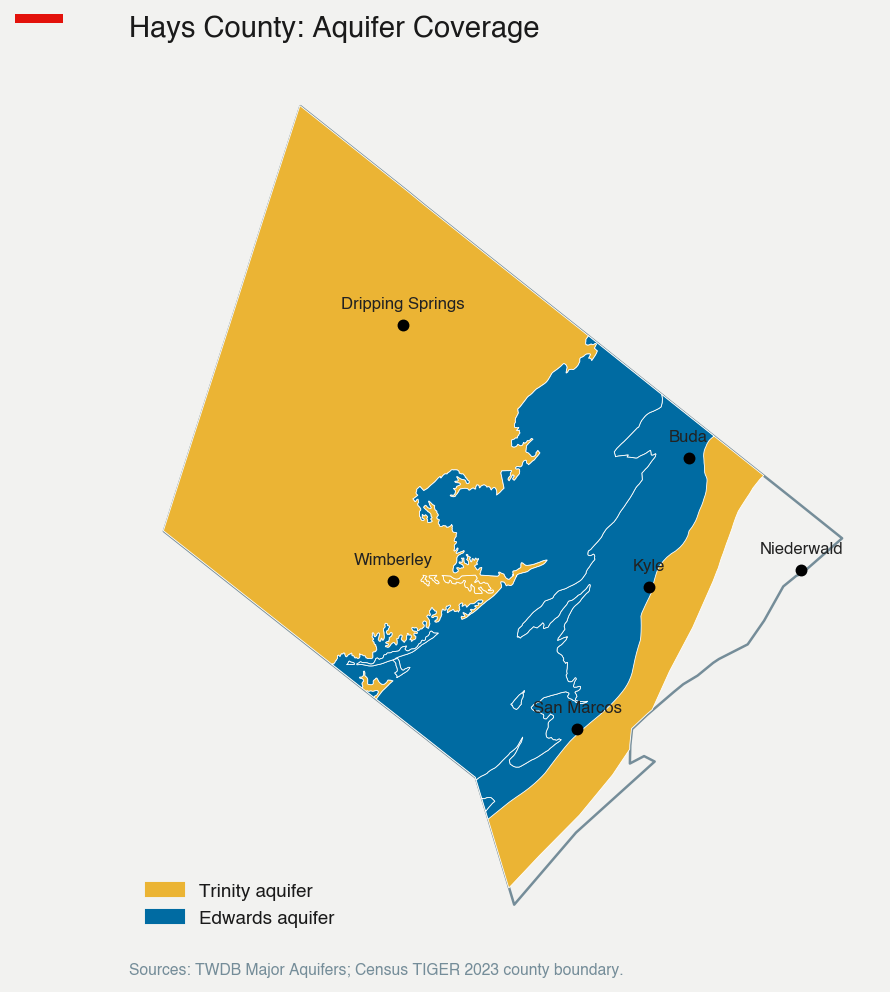
The map above is the spatial fact that drives everything else. Trinity covers most of the county. Edwards runs in a narrow north-south band along the eastern corridor where the population is densest. Buda, Kyle, and the eastern half of San Marcos sit on top of Edwards. Wimberley and Dripping Springs sit on Trinity. Niederwald, in the southeast, falls outside both major aquifer footprints and depends on imported supply through its retail provider.
The Districts
Texas does not have a single water regulator. It has groundwater conservation districts, which are local, and surface-water authorities, which are regional. In Hays County the relevant districts are:
- Barton Springs/Edwards Aquifer Conservation District (BSEACD), for the Edwards on the east side.
- Hays Trinity Groundwater Conservation District (HTGCD), for the Trinity on most of the rest.
- Edwards Aquifer Authority (EAA), for the part of the Edwards that feeds San Marcos Springs and points south.
- Guadalupe-Blanco River Authority (GBRA), for surface water flowing through the county.
A house in northeast Hays might be in BSEACD’s territory. A house ten miles west might be in HTGCD’s. A municipal customer in San Marcos is buying water that came through GBRA from Canyon Lake. The patchwork is not an oversight. It reflects the geology.
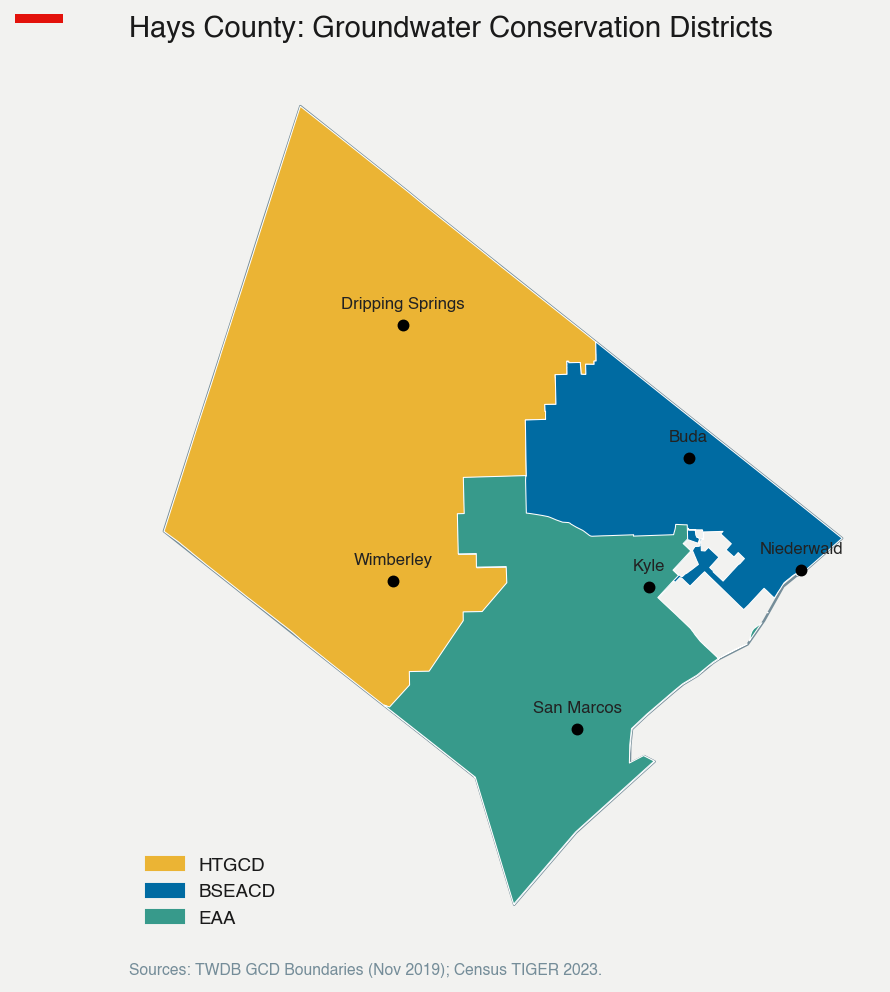
The district map shows the patchwork directly. HTGCD covers the western two-thirds of the county. BSEACD covers the northeastern corner. EAA covers a southern wedge that includes San Marcos. The small unshaded area near Niederwald is a real gap, not a drawing artifact, and it is part of why the eastern edge of the county has the kind of supply story it has.
What the districts have in common is that they are creatures of the legislature. Their authority comes from chapter 36 of the water code and from special legislation, and that authority varies. BSEACD can shut off pumping during drought. HTGCD has historically had to fight in Austin for even basic production-fee authority on existing wells. The 89th legislature attempted to expand HTGCD’s authority through SB 2660, which would have authorized pumpage fees not to exceed 38 cents per thousand gallons; that bill did not become law. The political economy of the two districts is therefore very different. One has tools. The other has had to ask for them.
What GMA-9 Does
Sitting above the local districts is Groundwater Management Area 9, which is a coordinating body that covers the Hill Country including Hays. Every five years GMA-9 sets what is called a Desired Future Condition, or DFC, for each aquifer in the area. The DFC is, in effect, a target for how much the aquifer can fall in average drawdown over the planning horizon. Once the DFC is set, the Texas Water Development Board calculates what is called the Modeled Available Groundwater, or MAG, which is the implied annual pumping ceiling consistent with that condition.
The MAG is what permits get measured against. If a district’s permits already add up to the MAG, additional pumping requests are supposed to be denied or reallocated. In practice the DFC-MAG-permit chain has been contested for years, and the Trinity numbers in particular have been the subject of repeated legislative and legal attention. The mechanism is real, but it does not move quickly, and it does not by itself stop a subdivision from being approved before the supply is locked in.
This is the gap that has shaped the last decade of growth on the Trinity side of the county. Subdivisions get platted. Wells get drilled. Some of those wells produce. Some of them do not. By the time the regional groundwater story catches up, the rooftops are already there.
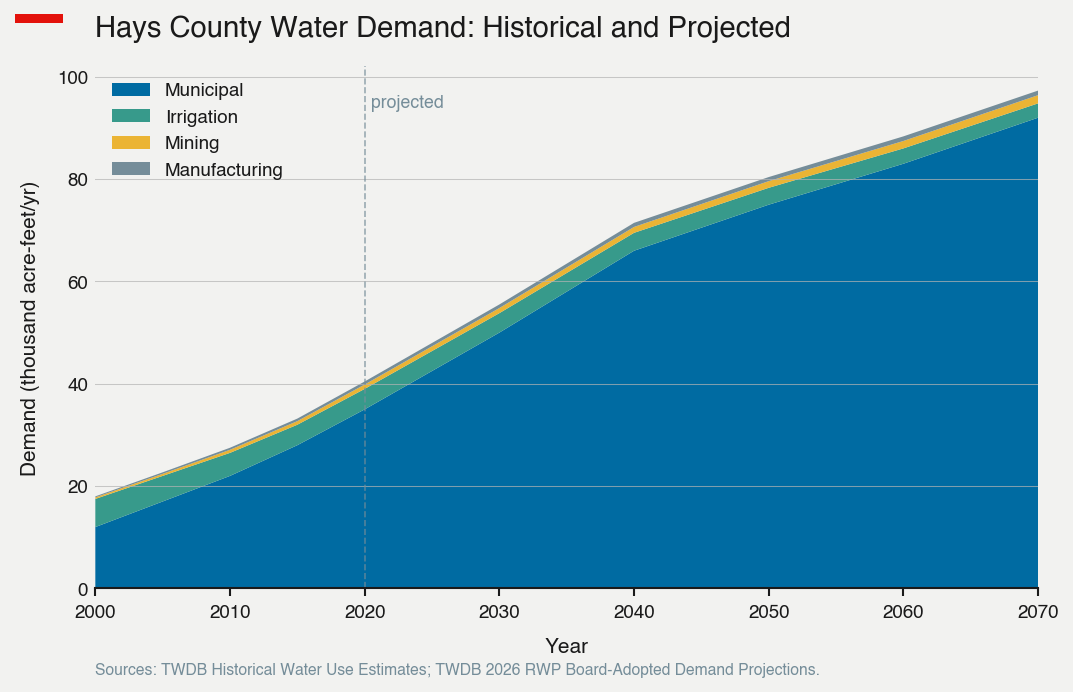
The chart above is the heart of the planning problem. Municipal demand has been the dominant category since the 2000s, and it is the line that scales with rooftops. Irrigation, mining, and manufacturing are roughly flat. So whatever growth scenario you accept from the previous post, it translates almost one for one into more municipal demand on top of the same fixed-supply Edwards and Trinity systems.
Kyle’s Move
Kyle is the clearest example of what a fast-growing Hays city has had to do to keep ahead of the supply curve. The city sits on the eastern edge of the county and was historically dependent on a mix of GBRA surface water and local sources. As the population roughly doubled through the 2010s, both city staff and the council recognized that the existing portfolio would not get them to a build-out population well above today’s count.
The answer was the Alliance Regional Water Authority, which Kyle co-founded along with San Marcos, Buda, and the Canyon Regional Water Authority. ARWA’s signature project is a Carrizo-Wilcox aquifer wellfield in eastern Caldwell and northern Gonzales counties, well outside the Hill Country, with treated water piped back into the I-35 corridor. The Carrizo treatment plant is being built out toward a design capacity of 39.5 MGD across all of the partner cities.
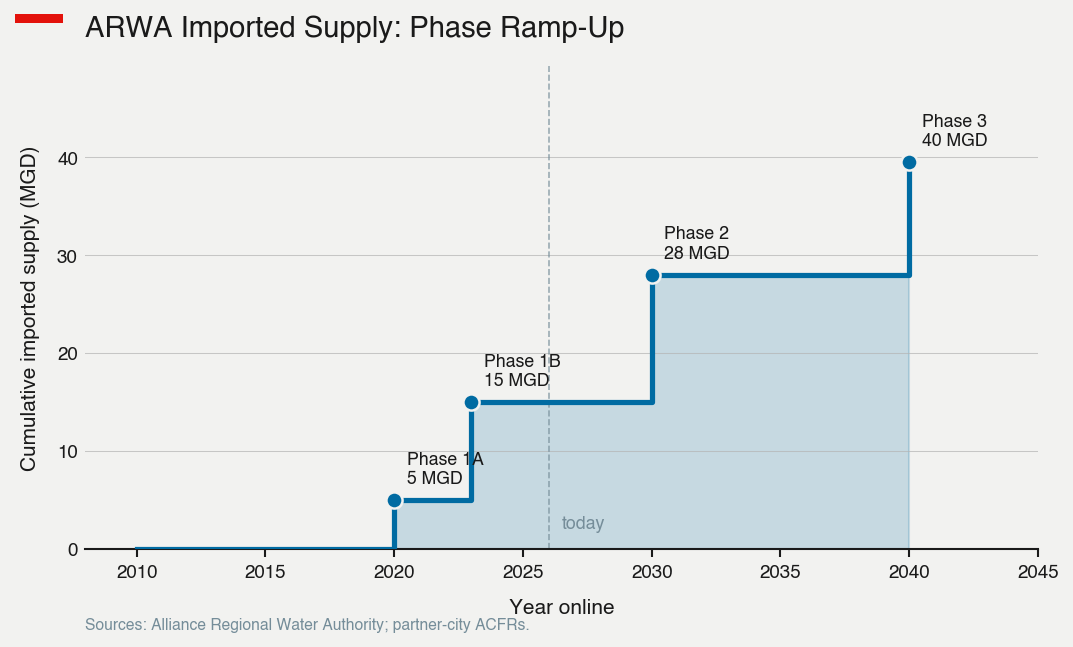
The Carrizo-Wilcox is a different aquifer entirely. It is regulated by a different groundwater conservation district, in a different basin, paid for through utility bills and through long-term debt issued by the participating cities. From a Hays County perspective, the deal effectively imports water across county and basin lines. That debt shows up in the cities’ annual financial reports and is one of the reasons that water-system operating costs are rising even when household consumption is roughly flat.
ARWA also carries a kind of political importance that goes beyond the cubic-feet-per-second numbers. It demonstrates that the cities along the corridor can pool capital to buy out-of-basin supply. That is good news for anyone whose growth scenario depends on more water arriving. It is less good news for taxpayers in the participating cities, because the cost of that water is now a structural fixed cost on the utility’s books, not a variable bill that scales with how much it rains.
Two Maps That Matter
If you want a single mental picture of the Hays County water story, hold two maps in your head at once.
The first is the aquifer map. The Edwards recharge zone runs in a thin diagonal band along I-35. Move west of the band and you are on the Trinity. Move east of it and you are on the Edwards proper, where the springs come out and the regulation is tighter. That geography sets the rules each parcel plays by.
The second is the city service area map. Kyle, Buda, and San Marcos can draw on ARWA, GBRA, and their own groundwater wells. Step outside their service areas, into the unincorporated parts of the county or into a small water utility that is not part of those agreements, and the supply story collapses back to whatever water can be produced from the well on the lot or in the subdivision. That is most of the western half of the county.
The two maps overlap in ways that are unintuitive. A subdivision technically inside a city ETJ but located on the Trinity might not be served by ARWA water. A new development east of San Marcos might be on the Edwards but tied to a small private utility with its own permitting story.
Where these maps disagree is where the supply risk lives.
What Comes Next
The forecasts in the previous post implied roughly two more Hays Counties’ worth of people over the next several decades. The water question is whether the existing supply portfolio can be stacked tall enough to serve that population at the per-capita demand levels Texas cities have historically planned around, or whether build-out is going to require either additional out-of-basin imports or a real change in what residential water demand looks like.
Three things are worth watching. First, the next round of GMA-9 DFCs, which will set the Trinity ceiling for the next planning cycle and will be contested. Second, ARWA’s phase-two and phase-three expansions, which determine how much imported water the partner cities can plan around. Third, the small utilities and the unincorporated subdivisions on the Trinity, which are where the supply story is most likely to break first.
The economic development story in Hays County is a story about water as much as it is a story about jobs or roads or rooftops. The infrastructure is being built. The bills are being issued. The aquifers are being measured. Whether all three add up is the question the next decade is going to answer.
Sources
Aquifers and groundwater regulation
- Texas Water Development Board, Major Aquifers GIS shapefile.
- Texas Water Development Board, Groundwater Management Area 9 and Desired Future Conditions overview.
- Barton Springs/Edwards Aquifer Conservation District.
- Hays Trinity Groundwater Conservation District.
- Edwards Aquifer Authority.
- Texas Alliance of Groundwater Districts, EDF case study on the Hays Trinity GCD.
- Texas Special District Local Laws Code, Chapter 8843 (HTGCD enabling statute).
- Texas Water Code, Chapter 36 (groundwater conservation districts).
- 89th Texas Legislature, SB 2660 bill analysis.
Springs and drought
- KUT, Jacob’s Well stops flowing for sixth time in recorded history (Aug 2023).
- Texas Monthly, Who’s Killing Jacob’s Well?.
Water demand and planning
- Texas Water Development Board, Historical Water Use Estimates.
- Texas Water Development Board, 2026 RWP Board-Adopted Demand Projections (municipal) and non-municipal.
- South Central Texas Regional Water Planning Group (Region L).
ARWA and surface water
- Alliance Regional Water Authority.
- Guadalupe-Blanco River Authority.
- City of Kyle, Alliance Water partnership.
Replication code and figures
Disclosure
This post was drafted with the assistance of Claude (Anthropic). Claude helped with research, drafting, map rendering, and code. All analytical decisions and editorial judgment are the author’s.
The author is an assistant professor at Texas State University in San Marcos and writes here in a personal capacity. The views expressed are his own and do not represent his employer or any of the entities discussed.