
254 Counties, One Interstate: The Hays County Growth Story
Published:
If you drive south from Austin on I-35, you can feel the moment you cross into Hays County. Not because of a sign — though there is one — but because the landscape opens up. New subdivisions in various stages of completion. Warehouse pads with fresh concrete. A strip center waiting for tenants. The feeling of a place in motion — growing into something, and doing it quickly.
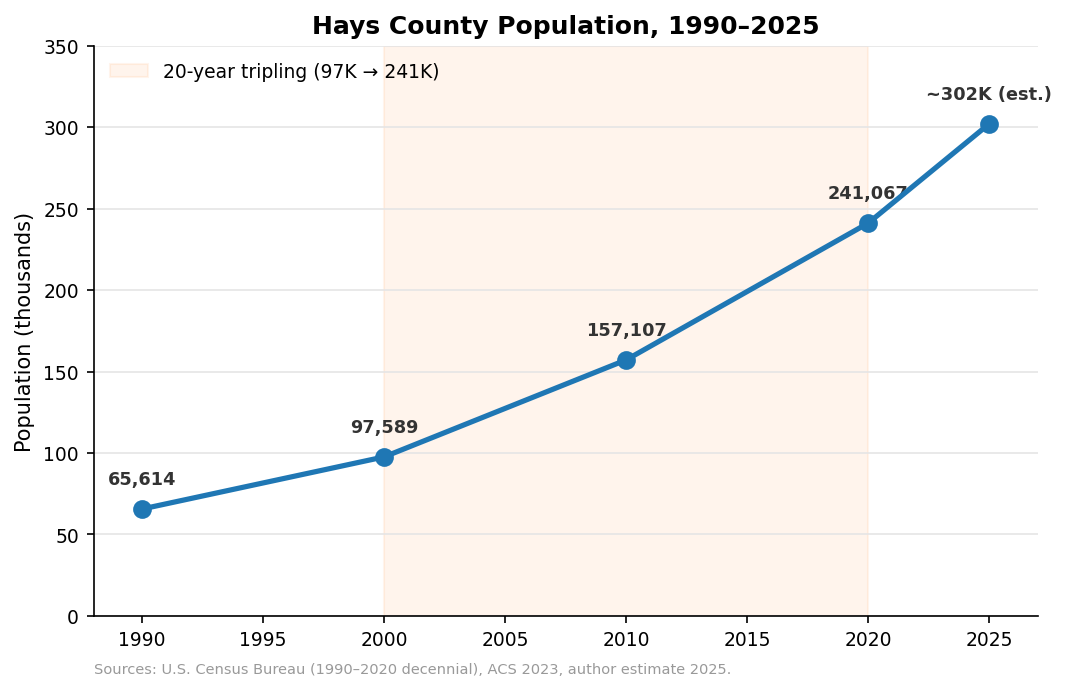
Hays County was the fastest-growing large county in the United States between 2010 and 2020. The Census Bureau measured it at 53.4 percent growth in a single decade, more than any other U.S. county with a population over 100,000. Between 2020 and 2023, the pace continued — second-fastest in the nation, adding another 16 percent.
The county had 97,000 people in 2000. It has roughly 300,000 today. It tripled in a quarter century.
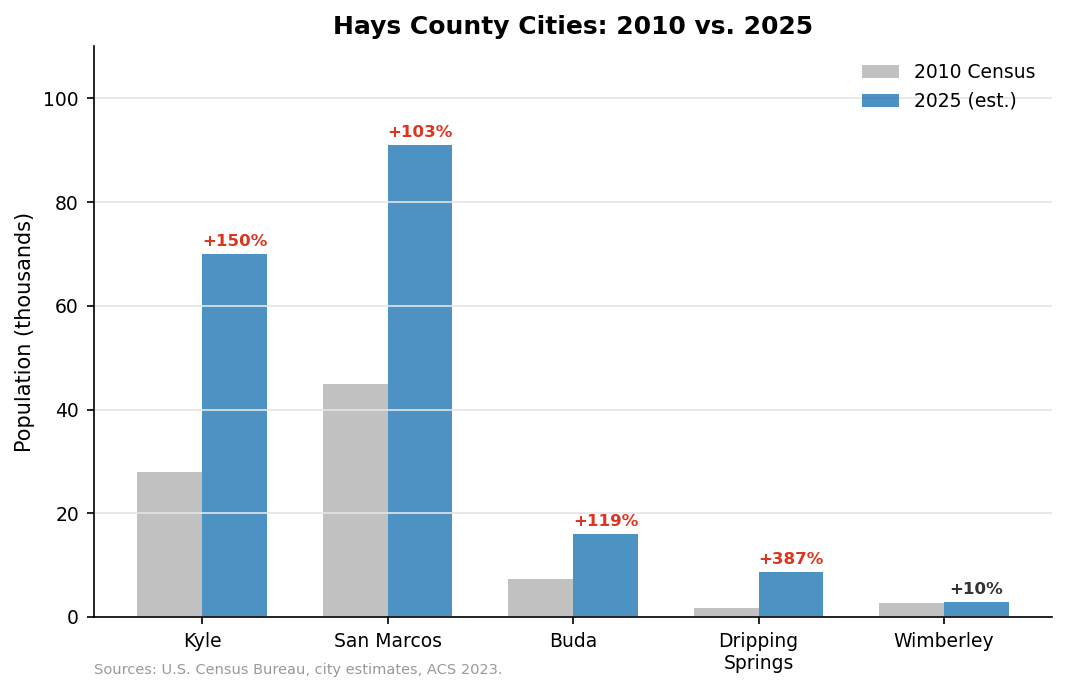
The growth has not been uniform across the county. Kyle — a city with 5,314 residents at the 2000 census — now has roughly 70,000. The Census Bureau ranked it the second-fastest-growing city in America among those over 50,000 in population. San Marcos, anchored by Texas State University, has doubled since 2010 and is approaching 91,000. Dripping Springs, on the county’s western edge, nearly quadrupled off a small base. Buda, sitting between Kyle and Austin, grew more modestly — an interesting contrast that deserves its own post down the road, because two cities five miles apart on the same interstate with very different growth trajectories is a story worth understanding.
The Engine
The growth has a straightforward cause. For many families, Hays County is where the math starts to work.
The median home in Travis County costs roughly $490,000. In Hays County, it is about $355,000 — $135,000 less for a home that is, in many cases, 20 minutes farther south on the same highway. I-35 connects the two counties seamlessly, and families looking for more affordable options have steadily moved south along the corridor.
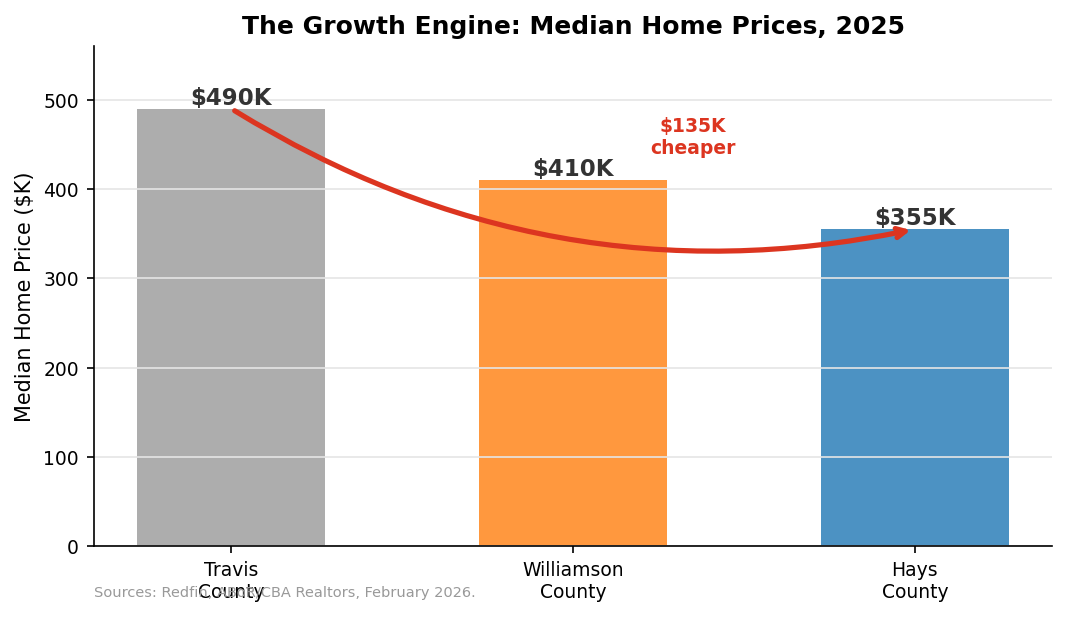
This is a familiar pattern in Central Texas. Williamson County experienced a similar wave north of Austin a generation earlier. Hays County is now absorbing that same energy — but faster, off a smaller base, and with infrastructure still catching up.
Kyle has been especially proactive in welcoming the growth. The Kyle/35 Logistics Park — five warehouse facilities totaling over a million square feet, representing $115 million in capital investment — was the first spec project of that scale ever built in the corridor. Developers are now building-to-finish rather than building-to-spec, with buildings leased before completion. The city is not just growing residentially — it is becoming a regional logistics hub.
Two Things Worth Watching
Beyond the headline growth numbers, two developments stand out as particularly important for the county’s future.
The county recently commissioned its first comprehensive water study since 2011. The population has nearly doubled since the last one, which means the county has been navigating a period of extraordinary growth without an updated picture of its most constrained resource. The study was approved by the Commissioners Court in January 2026 and will take time to complete. In the meantime, mandatory water restrictions are in effect in parts of the county, and boil water notices have become more frequent — a single notice in northern Hays County affected 11,000 customers. The county judge has proposed a moratorium on water-heavy industrial projects, though questions have been raised about whether Texas counties have the legal authority to impose one under recent state legislation.
Updating the water picture is an important step. The timing underscores how quickly the county has grown relative to its planning infrastructure.
In November 2024, voters approved a $440 million road bond for transportation improvements. Fifty-six percent voted yes. It covered 31 projects across mobility, safety, and regional connectivity, with a projected tax impact of two cents per hundred dollars of assessed value. In June 2025, however, a judge voided the bond, ruling that the Commissioners Court did not properly comply with the Texas Open Meetings Act when calling the special election. The ruling was about process, not substance — not the projects themselves, but the way the meeting was noticed. The county judge has since formed a transportation task force to chart a path forward, and as of this writing, $440 million in voter-approved infrastructure remains unresolved.
These are the kinds of challenges that come with rapid growth — not failures of will, but situations where the pace of development has outrun the pace of institutional capacity. They are worth understanding, and worth getting right.
What Comes Next
This is not a story about whether Hays County will keep growing. The affordability gap is significant, the corridor is well-connected, and the momentum is strong. CAMPO — the Capital Area Metropolitan Planning Organization — estimates the county could approach 628,000 people by 2040.
The more interesting question is how the county manages that growth — how it plans for water, funds infrastructure, educates a growing student population, and coordinates across the many jurisdictions that share responsibility for governing the county.
Sources
U.S. Census Bureau (decennial census 1990–2020, ACS 2023). City of Kyle Economic Development. City of San Marcos. Redfin. CBA Realtors. KXAN. KUT. Community Impact News. TxDOT. Hays County Commissioners Court.
Replication code: southbound-35/posts/hays-growth
Disclosure
This blog post was written with the assistance of Claude (Anthropic). Claude helped with data research and drafting. All analysis and editorial judgment are the author’s.